

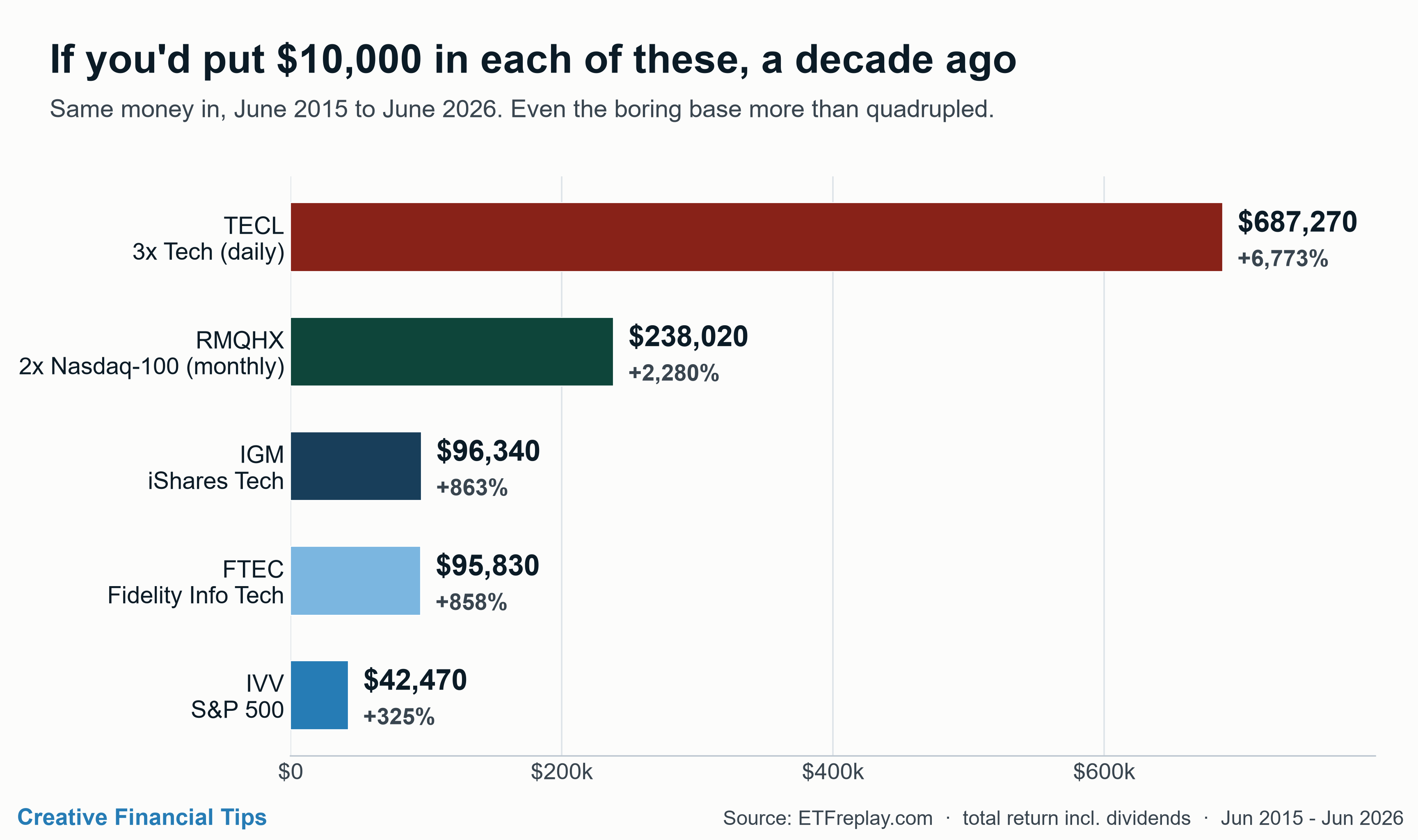
What $10,000 in each of these became over a decade, June 2015 to June 2026
Day trading is a full-time job. Options trading is another full-time job. Both will happily eat your evenings, your nerves, and usually your money.
Long-term investing is the opposite. You put money in, in a boring and diversified way, and you let it ride. You shouldn't be trading. You should be investing. You look at it in five and ten years, not five and ten minutes. And when you finally look back, you can have a literal fortune.
That's the whole game I play. I'm not a trader - I'm a long-term stock market investor, and these days that's where almost all of my focus goes. It's simple, it's about as passive as money gets, and the math has been hard to argue with.
Rule one: show me a ten-year chart
Whenever someone wants to talk investments with me, I say the same thing: let's look at a chart.
Most people want to talk about how a stock makes them feel, or that it was "up like 40% last year." I don't really care about any of that. One year is noise. Feelings are not a strategy. Pull up a five or ten year chart. If we can get both things we're comparing onto the same chart, great. If we need two charts side by side, fine. But we are looking at five to ten years, period.
And look at the right number. I send people to ETFreplay because it charts total return with dividends reinvested - the actual number you'd have in your account. Google Finance and Yahoo Finance mostly show price only, which quietly ignores dividends. That is idiotic, because total return with dividends reinvested is the only number that really matters. Everything below comes from one ETFreplay chart, June 2015 to June 2026.
Quick disclaimer before the specifics: I'm not a financial advisor and none of this is financial advice. It's just what I do with my own money. The leveraged funds near the end are genuinely risky - do your own homework.
Everyone's base should be the S&P 500
If you do nothing else, own the S&P 500 through a dirt-cheap index fund. I use IVV, the iShares Core S&P 500 ETF, at a rock-bottom 0.03% expense ratio. For most people this should be 70 to 90% of the whole portfolio. It is the base. Everything else is garnish.
Here's why I'm so boring about it: over the past decade, that "boring" S&P 500 fund turned $10,000 into about $42,000 - up 325%, dividends included. You more than quadrupled your money for doing nothing but owning the whole American economy and waiting.
It's also my favorite filter for any "exciting" opportunity. Real estate, crypto, whatever the new fad is - I compare it to what the S&P 500 did over the same window. If it didn't beat the index after all its extra risk and headache, then the index was the better call. Most of the time, it was.
A modest tilt toward tech
With the slice that's left, I tilt toward tech, because I believe in it for the long haul. For me that's FTEC (Fidelity's info-tech ETF, 0.08%) and IGM (iShares' tech ETF). Over that same decade, they roughly doubled the index - up about 858% and 863% against the S&P's 325%. Same buy-and-hold idea, just concentrated in the part of the economy I think keeps eating the world.
The gambling sleeve: 10% or less
Now the fun, dangerous part. Everybody wants the lottery ticket. Fine - but cap it at 10% of your portfolio or less, and call it what it is: gambling.
For me that's leveraged tech: TECL (3x daily tech), TQQQ (3x daily Nasdaq-100), and one mutual fund, RMQHX. RMQHX is a 2x Nasdaq-100 fund that rebalances monthly instead of daily, and that detail matters. Its closest ETF cousin is QLD (2x daily Nasdaq-100), but QLD slightly underperforms RMQHX over time, because daily resetting bleeds more to volatility than a monthly rebalance does.
How parabolic can this sleeve get? Over a decade, the 3x tech fund turned $10,000 into roughly $687,000. The 2x monthly fund, about $238,000. Those are not typos - and that is exactly why people get seduced into putting way too much here.
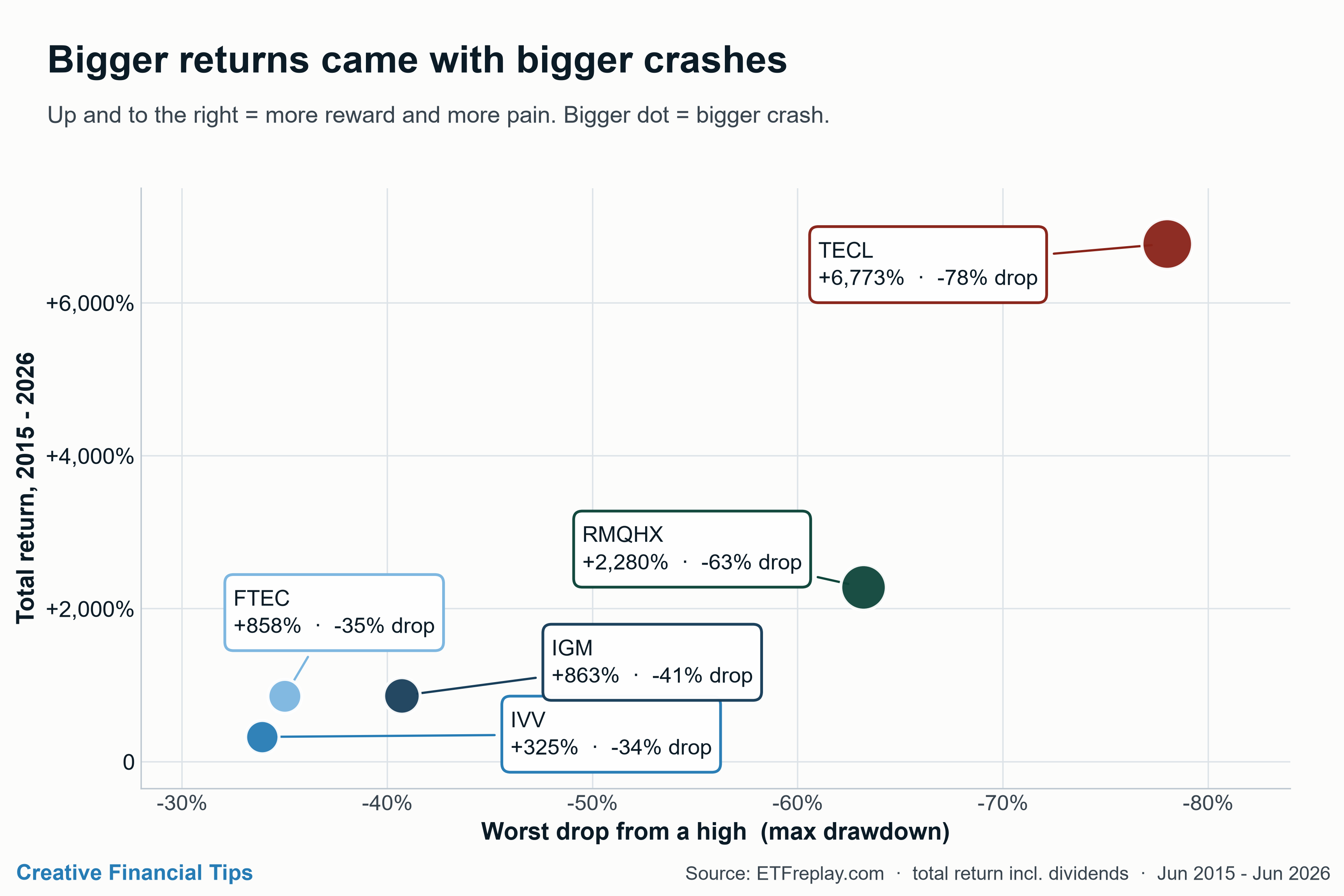
Bigger returns came with bigger crashes
The catch nobody puts on the brochure
Here's what the "I turned $10k into $687k" crowd leaves out: the drawdowns.
Higher returns came bolted to higher risk, and risk shows up as how far a thing falls when the market rolls over. In the last decade we had four major market downturns plus a handful of smaller scares, and every time, the more leverage you held, the deeper the hole.
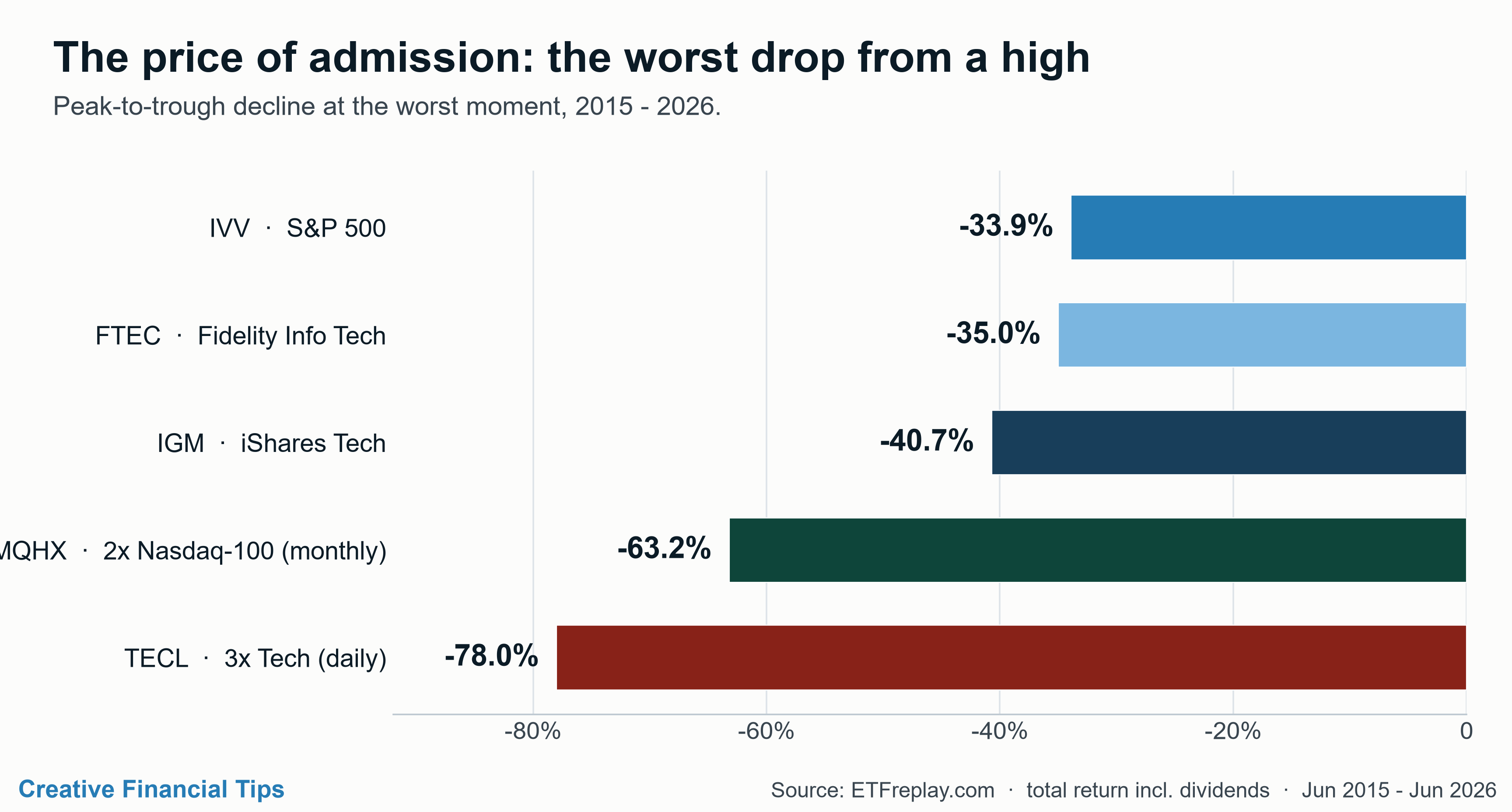
The price of admission: the worst drop from a high
The boring S&P 500 fell about 34% at its worst. The tech ETFs, 35 to 41%. The 2x monthly fund, 63%. The 3x daily fund fell 78% - it lost more than three-quarters of its value at the bottom. If you can't watch part of your money do that without panic-selling at the worst possible moment, you have no business owning the leveraged stuff. That is the entire reason it is capped at 10%: so a gut-wrenching drawdown there can't sink the whole plan.
The "decay" lecture you can ignore
You will meet a certain kind of person who cannot talk about leveraged ETFs without a ten-minute sermon on "daily rebalance decay" and "volatility drag." My blunt take: it mostly does not matter. Look at the chart.
Yes, the decay is real, and yes, it bites hardest when the thing is crashing - that 78% drop above is exactly what it looks like. But that is the whole reason this stuff lives in the 10% gamble sleeve and nowhere near your base. Inside that sleeve, over a long enough window, you do not argue with the theory - you look at the results. And the result was $10,000 becoming roughly $687,000.
The drawdowns are extreme; I will not pretend otherwise. But the long-run return is not touched by anything else on that chart. The decay did not stop it - and a decade of real results is a lot harder to argue with than a forum post about decay.
The playbook, in one breath
A big, cheap S&P 500 base. A modest tech tilt if you believe in it. A tiny, clearly-labeled gambling sleeve you could lose without losing sleep. A five-to-ten-year horizon. And the discipline to do almost nothing.
That's the whole thing. You shouldn't be trading - you should be investing. Put the money in, diversify, let it ride, and look back in ten years.
Want to run the numbers yourself? Here's the exact chart - total return, dividends reinvested, June 2015 to June 2026.
What's your base, and has anything "exciting" you've owned actually beaten the S&P 500 over ten years? Tell me in the comments.